This article describes the storage and storage of rolling mill bearings, precautions for maintaining rolling mill bearings, and typical failure analysis.
Keywords: rolling mill bearings; storage and storage; maintenance; failure analysis
Storage and custody requirements for rolling mill bearings
Bearings are precision mechanical components that have strict requirements for their storage and preservation.
(1) Warehouse temperature: Bearings are coated with anti-rust oil before leaving the factory. If the temperature is too low or too high, the anti-rust oil will deteriorate. The room temperature should be controlled at 0-25°C.
(2) Warehouse humidity: Excessive humidity will cause bearings to rust. The relative humidity of the warehouse should be maintained at 45%-60%.
(3) Warehouse environment: Bearings should be stored separately. When they must be stored together with other items, the other items stored together must not be chemicals such as acids, alkalis, and salts. Bearings should be placed off the ground and away from heating pipes.
(4) Regular inspection: According to the regulations on anti-rust of bearing products, regular inspection should be carried out every 10-12 months. If the oil seal packaging is found to be rusty, the oil seal packaging should be repackaged.
What precautions should be taken when maintaining and inspecting rolling mill bearings
Bearings should be maintained and monitored during use to extend their service life. Specific maintenance and monitoring matters are summarized as follows:
1. Keep the lubricating oil path unobstructed, select the type of lubricant according to regulations, and add sufficient lubricant regularly. Ensure that the rolling surface of the roller and the sliding surface of the roller and the rib are well lubricated by oil and wax.
2. Regularly check the sealing condition of the seals and replace damaged seals in time. Ensure the sealing performance of the bearing to prevent water and iron oxide scale from entering the bearing and prevent the leakage of bearing lubricant.
3. Based on the actual situation of the enterprise, actively carry out monitoring of bearing operating conditions.
Noise monitoring: There should be a steady hum during normal operation. Regularly monitor and compare with the normal sound to detect abnormalities in time.
Lubricant monitoring: Normal lubricant should be clear and clean. If the lubricant becomes dirty, there will be wear particles or contaminants.
Temperature monitoring: When the temperature rises, abnormal operation will occur.
Establish a record card: record the number of days the bearing has been used online, the amount of steel passed, and maintenance and monitoring status, etc., to strengthen the management of the bearing’s operating status.
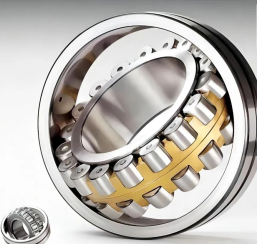
Analysis of several typical failures of rolling mill bearings
In addition to common failure causes of rolling mill bearings, there are also several typical failure situations. The following general rolling mill bearings are briefly explained for everyone.
1. Normal (typical) fatigue damage
Phenomenon: The surfaces of the raceways and rolling elements are broken and materials peel off; the vibration of the equipment increases significantly.
Reason: The service life exceeds the calculated fatigue life.
Action: Replace the bearing; consider installing a bearing with a higher load capacity.
2. Corrosion traces caused by corrosive media
Phenomenon: red/brown discoloration and/or slag-like matter on the rolling elements, raceways and cages; increased vibration, increased wear; increased clearance or reduced preload.
Reason: The bearing is used in an environment with corrosive media; the seal is worn or improperly lubricated.
Measures: Do not store corrosive substances in the surrounding environment; use sealed bearings; improve the effectiveness of external sealing systems; use moisture-resistant lubricants.
3. Foreign particle pollution
Phenomenon: (Contamination caused by foreign particles often causes peeling or dents in the load-bearing area of the bearing jacket) The dents caused by soft particles are shallow and have flat edge protrusions or peeling; the dents caused by hard particles are deep and have High edge protrusions; brittle particles are crushed during bearing operation, causing a large number of dents to appear on the protrusions with high edges; the bottom of V-shaped pitting corrosion formed in the rolling direction is the initial dent.
Reasons: Particles from the outside environment are brought in during assembly; various particles enter during seal wear and use; lubricating oil is contaminated and added directly without filtering.
Measures: Keep the workplace, hands and tools clean; keep the workplace away from grinding processes; only open bearing packaging before installation; improve/replace the sealing system.
4. Overheating damage
Phenomenon: Bearing rings, rolling elements and cages fade and change; bearing rings and rolling elements undergo plastic deformation; bearings may get stuck.
Reasons: (Generally, the specific reasons cannot be determined in depth) The clearance is too small (especially for high-speed applications); poor lubrication (improper viscosity, contamination); too much or too little lubricant; subsequent damage caused by cage breakage.
Measures: Increase bearing clearance; provide lubricant quality (viscosity, cleanliness); avoid overlubrication or lubricant poverty; ensure slow and even heating when there is an external heat source.
5. Slip
Phenomenon: Creep occurs on the surface; pitting occurs.
Reason: In the low load-bearing area, the rolling elements slip on the raceway and accelerate when entering the load-bearing area; rapid speed change.
Measures: Use bearings with lower load-carrying capacity; preload bearings (such as using spring preload); reduce bearing clearance; ensure a large enough load (trial operation); improve lubricants.
6. Poor lubrication
Phenomenon: The raceway in the low load-bearing area is dark gray; the high load-bearing area is pressure polished.
Reasons: Insufficient lubricant supply; operating temperature is too high (the viscosity of the lubricant is too low at the operating temperature); there is moisture contamination in the lubricant
Measures: Increase the lubricant supply; use higher viscosity lubricants; cool the lubricant and/or bearing locations; use softer grease; improve the waterproof performance of the sealing system.