The operating conditions of the backing bearing of the twenty-high rolling mill are very different from that of ordinary bearings, so it has higher requirements for its performance and accuracy. This article will mainly analyze the installation, use and related maintenance methods of the 20-high rolling mill backing bearing.
Keywords: 20-high rolling mill; backing bearing; maintenance
Abnormal scrapping of bearings causes bearing consumption to remain high, affecting the cost of steel per ton. Therefore, it is very important to master the relevant maintenance methods of backing bearings. The backup rolls of twenty-high rolling mills usually adopt a multi-fulcrum beam structure (that is, they are composed of multiple cylindrical rollers to bearings, saddles, and mandrels). Since the twenty-high rolling mill adopts a tower-shaped roll system, the rolling force is transmitted from the work roll through the intermediate roll to the backing bearing of the outer support roll in a fan-shaped manner. The backing bearing will bear the load evenly through the mandrel and saddle. It is transferred to the frame, so the stiffness of the rolling mill is relatively large, and the deflection deformation of the roll is small, so that high-precision strips can be rolled. In addition, the dimensional accuracy of the backing bearing determines whether the rolling force is evenly distributed.
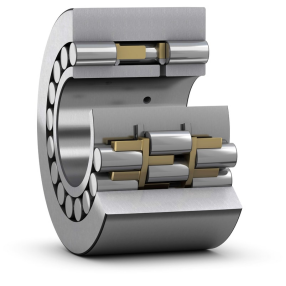
Structure and usage conditions of backing bearings
There are certain differences in the use conditions between backing bearings and ordinary bearings. For example, ordinary bearings have a fixed outer ring and a rotating inner ring, while backing bearings are just the opposite; secondly, backing bearings have high speed, frequent speed changes, and large loads. . The conditions for use of backing bearings are as follows. First, the overall thickness of the outer ring and the thickness of the grinding layer must be sufficient to ensure that the outer ring has a certain bearing capacity. Second, the outer ring of the backing bearing must have sufficient impact resistance. , quenching can be applied to achieve this purpose; third, the fatigue resistance of the inner ring; fourth, ensuring the fatigue resistance of the rolling elements, this performance requires focus on material selection and shape design.
Installation requirements for backing bearings
The dimensional accuracy of the backing bearing is extremely high, the error of the inner and outer rings is usually less than 5μm, and the maximum wall thickness point is marked with an arrow. During the installation process of backing bearings, the first thing to do is to install backing bearings of the same size on the same shaft, keeping the outer circumferential surface in the same direction. On the contrary, if the backing bearings are not oriented in the same direction according to the installation standards, it will cause the backing bearings to vibrate abnormally during operation, aggravating roller fatigue, which will not only seriously reduce their operating life, but also greatly affect product quality.
During operation, the wear of each backing bearing is different. The main reasons are divided into two points. The first is that when the width of the rolling strip is narrower than the maximum rolling width of the rolling mill, the backing bearing in the middle of the roll is The load borne is greater than the load borne by the backing bearings at both ends of the roll, and the wear is relatively serious; secondly, because the external shaft of the twenty-high rolling mill has to bear much higher loads than the internal shaft, this will also directly increase the external load. The degree of wear of the shaft’s backing bearings. It can be concluded that in order to ensure and increase the service life of the backing bearing, the position of the backing bearing should be replaced at regular intervals and records should be kept at the same time. Generally speaking, when the running time of the backing bearing reaches between 400 hours and 1000 hours, its position needs to be changed. In addition, since the inner ring of the backing bearing is in a stationary state on the spindle, only a quarter of the ring surface is the load area. In summary, regularly rotating the inner ring to another load area can effectively improve the performance of the bearing. The operating life of the backing bearing.
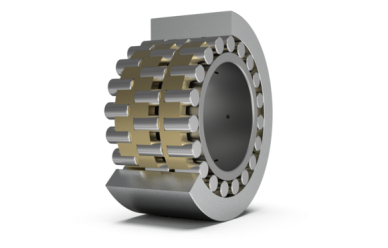
Lubrication of backing bearings
The force-bearing principle of the twenty-high rolling mill is that the rolling force generated on the small-diameter work rolls passes through a series of larger rolls and is finally transmitted to the frame by the backing bearing. Therefore, lubrication plays an extremely important role in the maintenance of backing bearings and will be directly related to the service life of the bearings. The lubrication function of the backing bearing has many functions, such as reducing the friction of related components, protecting the bearing surface from damage, removing foreign matter, and finally cooling the bearing.
The lubrication system is divided into two parts: the rolling mill process lubrication system and the backing bearing lubrication system. First of all, according to the differences in rolling processes, process cooling lubricants usually use emulsion and mineral oil. The advantage of mineral oil is that it has good lubricity, which can effectively reduce the rolling force, extend the service life of the roll, and also allow the strip to obtain good surface quality. However, the disadvantage is that the cooling capacity is weak, and the economic cost is relatively low. Higher, usually used in small and medium-sized rolling mills. The other is emulsion. The main advantage of this lubricant is its strong cooling effect. It is usually used in large rolling mills or high-speed rolling mills. Because emulsions have the characteristics of having a lot of water, and compared to oil, water has twice the heat capacity and ten times the latent heat of evaporation, so emulsions can absorb a large amount of heat in a very short period of time.
Shared lubrication system
When mineral oil is used in the process lubrication system, in order to avoid product contamination, the same lubrication system is usually used as the backing bearing. According to the characteristics and usage requirements of multi-roll mills, lubricating mineral oil with low viscosity characteristics is the best choice. But at the same time, this mineral oil also has certain shortcomings, that is, it cannot provide sufficient bearing lubrication. In order to solve this problem, the lubricating oil flow rate needs to be increased. If the lubricating oil flow of the backing bearing is insufficient, the outer ring of the bearing may be deformed or damaged. Generally speaking, the filtration precision of mineral oil must be less than 5 μm to meet the usage standards and effectively extend the service life of the bearings. Based on work experience, the lubricating oil dosage range for different backing bearing diameters is summarized. For example, if the backing bearing diameter is 110/mm~120/mm, the recommended lubricating oil dosage is 5/L·min- 1~7/L·min-1 ; The diameter of the backing bearing is 160/mm~165/mm, the recommended lubricating oil dosage is 10/L·min- 1~15/L·min-1; the backing diameter is 220/mm~225/mm, the recommended lubricating oil dosage is 15/L·min-1~25/L·min-1.
Independent lubrication system
Generally speaking, when emulsions are used for process lubrication, a separate lubrication system must be used for the backing bearing. The main reason is that the moisture contained in the emulsion will have an erosive effect on the bearings. Currently, the more common independent lubrication systems include oil mist lubrication and circulating thin lubrication. The oil mist lubrication system mainly includes oil-water filters, pressure reducing valves, oil mist generators, air heaters, oil heaters, etc. Although this system is a reliable method, it is often subject to various constraints during production operations, resulting in unsatisfactory actual results. For example, the atomization ability and atomization temperature of lubricating oil have higher requirements. According to practice, among the many rolling mills introduced in our country, because the oil mist lubrication system did not bring ideal results, they eventually had to be abandoned and replaced with emulsion lubrication similar to process lubrication. In addition, if a circulating thin oil lubrication system is used, a backing bearing with an integral sealing device is required to prevent the emulsion from being contaminated.
Regrinding of backing bearings
Backing bearings will gradually suffer various damages during operation, such as flattening, pitting, etc. According to practical experience, backing bearings need to be regrinded and maintained after operating for up to 3,000 hours. Grind the backing bearing on the roll grinder and operate according to the standard process, otherwise the bearing will temper during operation. In addition, the repair status of the workpiece for regrinding and maintenance is determined by factors such as the hardness, material, and roughness of the workpiece. According to experiments, ceramic alumina grinding wheels are required for grinding the outer ring of the backing bearing. The grinding wheel needs to be strictly ground before use. The linear speed of the grinding wheel is controlled at 25m/s~30m/s. It should be used during the grinding process. The emulsion is cooled. The main purpose of using emulsion is to prevent the grinding surface from heating up and at the same time flush the grinding to keep it clean.
The chamfers and fillets of the outer ring of the backing bearing that need to be regrinded will be worn away little by little when repaired. Therefore, it is necessary to avoid the stress concentration area during the application process, re-grind the edge chamfers, and at the same time chamfer The transition zone between corners and columns is polished. We use professional micrometer instruments to detect the regrinding of the outer ring, mark the measurement results, and determine the maximum wall thickness point based on the data display. In order to keep the regrinding accuracy of the backing bearing within a controllable range, it is necessary to adopt advanced cutting technology and select suitable cutting tools. This time we will introduce several regrinding methods in detail. The first method is to grind the backing bearing as a whole. In this method, the first step is to fix the grinding mandrel and the backing bearing. Use the threads on the bearing to lock the tapered bushing and the nut, and the inner ring will expand. , the purpose of this method is to fully fill the internal gaps,
The last step is to align the outer ring rolling elements with the cage. The disadvantage of this regrinding method is that it takes a long time. It requires the entire backing bearing to be disassembled and installed, and the measurement accuracy also takes a lot of time. The second method is to grind the outer ring separately. This method is very commonly used and its main advantage is that it is simple to operate. Place the outer ring device on the grinding mandrel, use hydraulic method to expand the mandrel, clamp the bearing outer ring, and then the grinding operation can be carried out. The third method is to grind the outer ring in groups. The main advantage of this method is to ensure that the backing bearing is evenly stressed on the same support shaft. According to relevant literature, the outer ring is ground in groups. In order to ensure accuracy, the grinding mandrel and the bearing outer ring must be closely matched, so induction heating is required to heat the outer ring before it can be installed on the mandrel. In the same way, when the outer ring is removed, induction heating is also required. It should be noted that in order to ensure that the outer ring can be installed and removed smoothly, water cooling must be used to prevent the mandrel itself from being heated.
Conclusion
In summary, correct installation, reasonable lubrication, timely regrinding and careful maintenance are of great significance to ensure the accuracy of the 20-roll mill backing bearing, extend its service life and improve product accuracy.