Keyword: rolling mill bearings; stable operation; mechanical seal; installation and maintenance
Rolling mill bearings often operate for a long time in a series of harsh environments such as high temperature, heavy load and frequent impact load. During the rolling process, the cooling water required usually penetrates into every hole, which can easily affect the actual lubrication effect of the bearing. In order to improve the sealing effect of bearings, it is necessary to conduct in-depth discussions on the installation and maintenance of mechanical seals, so as to improve the sealing quality of rolling mill bearings and ensure that the rolling mill can operate stably and efficiently.
Overview of mechanical seal
Mechanical seals mainly refer to at least one pair of end faces that are effectively perpendicular to the corresponding rotation axis. At the same time, under the continuous action of fluid pressure and the elastic force of the compensation mechanism, as well as the close cooperation of auxiliary seals, they can maintain fit for a long time and be able to slide relative to each other. A device that prevents fluid leakage. In 1885, mechanical seal technology was born in the United Kingdom. my country has developed relatively late in this field. At this stage, the pressure that mechanical seals can withstand can reach more than 42MPa. The actual withstand temperature is about 190~450℃, and the rotation speed is close to 50000r/min. PV The value can reach 1000MPa·m/s. It is essentially a corresponding shaft seal device specially used for rotating machinery, such as centrifuges or compressors. Since the transmission shaft generally runs through the inside and outside of the equipment, there is often a circumferential gap between the shaft and the equipment. These equipment The medium in the oil tank can continue to leak outward through this gap. Therefore, a high-quality oil seal device that can prevent leakage must be installed. At this stage, there are many types of oil seals, and mechanical seals have become a widely used shaft sealing method for various types of equipment due to their many advantages such as low leakage and long service life. Mechanical seals have certain technical requirements during the actual installation process, as shown in Table 1.
Table 1 Technical requirements for mechanical seal installation
| project | Specific requirements |
| Shaft curvature requirements | Generally controlled within 0.05 mm |
| Gland requirements | The general tolerance of the concentricity of the gland and the corresponding sealing joint to the center line of the shaft is 0.05 mm. At the same time, the maximum tolerance of the actual verticality of the plane in contact with the gasket to the center line is controlled to be 0.03 to 0.05 mm. |
| Shaft coupling requirements | The alignment error of the coupling should be controlled between 0.08 ~ 0.10 mm for gear couplings and 0.05 ~ 0.06 mm for elastic couplings. |
| Rotor vibration requirements | The vicinity of the corresponding shaft sleeve at the dynamic ring seal should be controlled within 0.06 mm. |
| Axial movement requirements | The actual amount of movement is controlled at ±0.5 mm. If a bushing is provided, the bushing is usually not allowed to be loose. |
Design analysis of rolling mill bearing mechanical seal
A domestic steel rolling company was established in 1999. Its business scope is relatively wide, such as ferrous metal smelting and related rolling products and by-product manufacturing, ferroalloy, automobile steel plate processing and manufacturing, and metallurgical raw and fuel material processing. The company’s revenue in 2021 reached 21.68 billion yuan, an increase of nearly 31% compared to 2020. A variety of steel rolling mills are used in the actual production and processing process, such as: blanking machines, profile steel mills, plate and strip mills, and steel pipe rolling mills. , in order to improve the sealing effect of various rolling mill bearings, the company used mechanical seals, modified and designed related seals, and achieved good sealing effects.
As shown in Figure 1, the working principle of a mechanical seal is mainly to change the geometric shape of the seal, and then make scientific use of the effects of gravity and centrifugal force, so that the water flowing through (can be changed to cooling) can smoothly follow the bearing box discharge. In terms of bearing mechanical seal design, the sealing cover on the side close to the roller is designed as a labyrinth sealing cover. An O-ring is added to the contact surface between the sealing cover on both sides and the inner hole of the bearing seat, thereby effectively preventing cooling water from flowing into the bearing seat. The positioning sleeves on the left and right sides of the bearing are in close contact with the lip seals. During the high-speed rotation of the roller, the two move relative to each other. Therefore, the positioning sleeves are made of 42CrMo and the surface is heat treated to improve its wear-resistant life. A groove is designed on the surface of the positioning sleeve close to the roll side to throw the cooling water passing through the labyrinth seal cover in the radial direction, reducing the pressure on the lip seal and effectively reducing the probability of cooling water penetrating into the bearing seat.
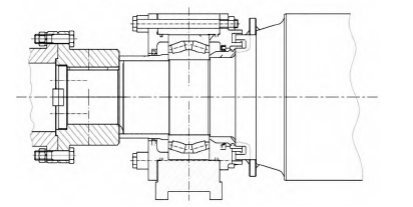
Figure 1 Bearing mechanical seal design
Analysis of installation strategies for rolling mill bearing mechanical seals
The mechanical sealing device is a very high-precision component, as shown in Figure 2 on the following page. During the actual installation process, it must not be hit hard, and it must be handled with care to ensure that the sealing device operates stably and achieves the ideal sealing effect.
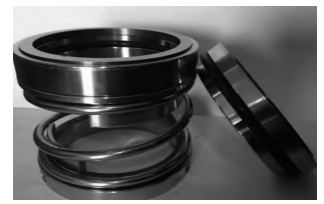
Figure 2 Mechanical seal
Make preparations before installation
Before actually carrying out the installation work of the rolling mill bearing mechanical seal, it is necessary to make preparations for the installation, which mainly include the following aspects:
1) The staff carefully inspects the specifications and models of the mechanical seals to be installed to ensure that all contents are accurate, and at the same time strictly checks whether there is any lack of relevant parts.
2) Check in detail whether the mechanical seal components are damaged, especially the corresponding sealing end faces of the static ring and the moving ring. It is necessary to strictly check whether there are bruises. If there is damage, the damaged parts must be repaired or directly replaced. In addition, a series of sealing components should be cleaned with kerosene or gasoline. During the cleaning process, ensure that the cleaning is sufficiently clean until there is no foreign matter or dust on the component surface.
3) Carry out a comprehensive inspection of the surface of the shaft or sleeve, the inner wall of the seal cavity and the inner surface of the corresponding seal end cover to ensure that there are no grooves or burrs. Once the above problems exist, they must be smoothed and polished in time. After completion, they must be cleaned with kerosene or gasoline to ensure that each part is clean enough until there is no debris and dust on the surface of each part.
4) When scrubbing the surface of the moving and static rings, it is strictly forbidden to use unclean cotton gauze or cloth. It is necessary to use absorbent cotton and clean soft gauze to ensure thorough and clean cleaning.
5) During the actual assembly process, all links must be clean and clean. At the same time, it must be ensured that the sealing ends of the static ring and moving ring will not be scratched or broken during the actual installation process. In order to enhance the convenience of installation and further reduce the difficulty of installation, an appropriate amount of engine oil should be applied to the surface of the shaft or sleeve, and the end faces of the moving and stationary rings should also be applied to avoid dry friction during the actual starting process, thereby effectively protecting the mechanical performance .
Installation steps of rolling mill bearing mechanical seal
In order to improve the efficiency and quality of mechanical seal installation, installation operations are carried out in accordance with relevant steps, as follows:
1) The corresponding geometric dimensions and actual machining accuracy of the parts must meet the drawing requirements, especially the dimensions forming the water channel must meet the requirements. According to the requirements of the assembly drawing, clarify the actual installation position of the rotating parts and make reasonable adjustments.
2) Before actually carrying out the assembly work, mechanical lubricating oil should also be applied to the rollers, and the parts should be scrubbed at the same time to avoid the entry of debris or dust, which would adversely affect the actual quality and effect of the mechanical seal.
3) During the actual parts installation operation, ensure the corresponding installation position of each part and make appropriate and reasonable adjustments to avoid changes in the installation position due to dimensional errors in parts processing.
4) The installation of mechanical seals should be carried out in the specified order and in accordance with relevant regulations. Violent knocking and bumping are strictly prohibited during the process. In addition, the sealing fastening screws of the bearing box should be tightened evenly to prevent leakage problems caused by inconsistent screw tightness or deflection of the end cover.
5) After the installation work is completed, you should carefully check whether the auxiliary device is in normal condition to avoid dry friction. Pay attention to observe whether there are any abnormalities when turning the machine. It can be run in for a period of time before delivery.
Analysis of daily maintenance work of rolling mill bearing mechanical seals
In order to ensure the safe and reliable operation of the rolling mill bearing mechanical seal, scientific and reasonable maintenance and maintenance of sealing parts must be carried out in daily work. The specific methods are as follows:
1) Before actual driving, conduct a comprehensive and careful inspection of the specific installation sequence of the mechanical seal and the configuration of all parts.
2) Gently rotate the roller with your fingers. Under normal circumstances, you can feel that the rotation is extremely brisk and there will be no resistance. This proves that the various components of the mechanical seal are installed normally and operate reliably.
3) During the actual rotation process, carefully check whether the bearings are lubricated enough and whether there are any abnormal sounds, etc.
Do a good job in handling common faults of mechanical seals
1) Overheating and smoking problems occurred during the actual rotation process. The reasons that lead to such malfunctions generally include: relatively low size and shape accuracy of processed parts; deformation of parts during actual transportation or maintenance; parts being beaten during actual installation, resulting in deformation; The parts themselves were installed in the wrong order.
The specific treatment methods mainly include: before actual installation, carry out strict inspection of all parts based on the drawings, especially the matching dimensions and the geometric accuracy of the parts themselves, etc., which need to be inspected; carry out special management and inspection of sealing parts. Storage work to avoid deformation of parts due to unreasonable storage, etc.; avoid collision with heavy objects as much as possible during transportation; it is strictly prohibited to use a sledgehammer to knock the seals during installation. Generally, the heat treatment method can be used to heat the parts in advance. Then use a small hammer to tap until it is finally in place.
2) After completing the sealing operation, a small amount of water still enters the bearing box. The causes of such problems are: after the installation work is completed, the seals are tilted or the geometric accuracy of the parts is problematic; the mating surfaces of the rollers and the corresponding seals have inappropriate geometric dimensions and cannot form a good interference fit; The corresponding seal on the bearing housing has quality problems or is damaged.
The specific treatment methods mainly include: strict inspection of parts according to the requirements of the drawings; cleaning work during the actual assembly of parts; careful inspection of the sealing gasket of the bearing box, and timely replacement if there are quality problems or damage.
Conclusion
The mechanical seal of the rolling mill bearing is a key measure to ensure the stable and efficient operation of the rolling mill and extend its service life. Effective installation and maintenance of the rolling mill bearing mechanical seal can improve the installation level of the mechanical seal and reduce the occurrence of safety accidents.