Based on the structural characteristics and working conditions of rolling mill bearings, this paper analyzes the precautions and related requirements during the assembly, use and maintenance of bearings in view of the phenomenon of high bearing consumption.
Keywords: rolling mill; bearing; assembly; load; maintenance
The roller bearings are used to support the rotating rollers and maintain the correct position of the rollers in the frame. The roller bearings should have the characteristics of small friction coefficient, sufficient strength and stiffness, long life and easy roll replacement. The plate and strip workshop of the steelmaking plant has 20 C50.01.100C rolling mills, 6 of which are installed online. Each rolling mill is equipped with 4 sets of FCD6084300 cylindrical roller bearings. In 2003, a total of 219 sets of bearings and 388 sets of FCD6084300/02 inner sets were consumed, with a total value of 1.276 million yuan. Reducing bearing consumption is an important measure to reduce costs.
Analysis of the working conditions and damage causes of the two-high rolling mill
The production conditions of the two-high rolling mill are harsh, with high temperature and large amounts of dust. When the rolled piece passes through, due to the influence of cooling water, the surface temperature drops rapidly and remains at 70°C to 90°C. However, the internal temperature is still very high because there is no cooling, and dust from the rolling process sometimes enters the rolling mill. Therefore, the damage rate of rolling mills is quite high, with an average of one every 48 hours. The damage of rolling mills is mainly caused by the damage of bearings. Bearing damage accounts for more than 90% of the damage of rolling mills. After long-term investigation, we found that many bearing damages are not caused by the quality of the bearing itself, but due to the assembly quality and use errors of the bearing. It can be seen that adopting correct usage methods and reasonably assembling and maintaining bearings are the key to extending the service life of bearings.
FCD6084300 bearing structure analysis
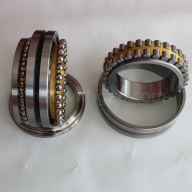
The four-row cylindrical roller bearing used in the plate and strip workshop of the steelmaking plant is FCD6084300, which is provided by two bearing factories in Handan and Beijing. Its structure is basically the same, it is a double inner sleeve and double outer outer comb cage bearing, which is mainly composed of four parts: outer sleeve, inner sleeve, rolling elements and cage. This kind of bearing has a dynamic load capacity of 2305 kN, a static load of 6565 kN, and a limit speed of 915r/min. The rotation accuracy is high, the inner and outer outer sleeves are separable and interchangeable, and the geometry is simpler than other bearings. The rolling elements and raceways of this kind of bearing are both cylindrical, so high machining accuracy can be achieved, thereby ensuring the assembly accuracy of the bearing.
Influencing factors and assembly requirements
Factors affecting assembly quality
1. The life of the bearing is inseparable from the design of the bearing seat. If the bearing seat is improperly designed and manufactured, it will cause uneven stress on the bearing and reduce the bearing life. The bearing seat should be self-aligning to prevent the bearing from being unbalanced due to roll deflection and deformation.
2.Whether the size, geometry, accuracy level, and tolerance range of bearing-related spare parts are consistent with the design.
3.Whether the smoothness and hardness of the contact surface mating with the bearing are within the specified range; whether all gaps and interference fits meet the design requirements, etc.
Installation of inner sleeve
The inner sleeve and roller neck of the four-row cylindrical roller bearing should have an interference fit and be heated to about 100°C during installation and shall not exceed 120°C. Usually heated with induction heater or engine oil, it is prohibited to use cutting torch to bake. When the inner sleeve is installed on the roll neck, make it in close contact with the water retaining ring to prevent the water retaining ring from moving. The two inner sleeves must be close together and there must be no gap.
Installation of jacket
The outer shell of the four-row cylindrical roller bearing is excessively matched with the inner hole of the bearing seat. During assembly, gently drive the outer shell, roller and cage into the bearing seat with a copper rod, and close the inner fixed end cover. When installing the outer sleeve, pay attention to the markings on the end face and the end face of the cage. Do not install it upside down. Install it in the order it was in the initial state when unpacking the bearing to prevent the bearing from burning due to uneven stress on the rollers. When installing the bearing, the bearing seat should be placed horizontally. After the bearing is installed, its stress range should be marked for inspection when replacing the roller.
Inspection and maintenance of bearings
Inspection during operation
In accordance with the requirements of the process regulations, the bearings are listened to, observed and measured on a regular basis. Listening is to use a prescribed instrument with one end facing the axial end cover of the bearing and the radial shell of the bearing seat, and the other end placed against the ear to listen for impact sounds and mechanical friction sounds during the operation of the bearing. Observation is to observe the operating environment, installation position, vibration offset, lubrication, etc. to see if there is a bad environment; measurement is to use a thermometer and vibration meter to quantitatively detect the bearing seat.
Through the above three methods, it can be determined whether the bearing is in normal condition during operation and the corresponding measures should be taken. The faults and preventive measures that occur during bearing operation are shown in Table 1.
| Fault phenomenon | Cause Analysis | Prevention and measures to be taken | |
| Audio | high frequency continuous sound | The internal clearance of the bearing is too small and the internal load is too large | Correct the internal clearance preload and fit interference of the bearing, and adjust the movement of the free side bearing. |
| Poor lubrication | In general, the viscosity of the lubricant and the amount of lubricant should be increased | ||
| Installation error | Check the shape error and installation accuracy of the shaft and bearing housing, and adopt the correct installation method | ||
| Mutual contact and friction of rotating parts | Check the contact condition of the bearing itself or the end cover seal, and replace the seal if necessary | ||
| low frequency continuous sound | There are scars, defects or unclean lubricant on the bearing raceway surface. | Clean the bearings, use clean lubricant, and check the working condition of the bearings. | |
| Low frequency irregular continuous sound | Clearance is too large | surface, replace with new bearings if necessary | |
| Foreign matter enters | Adjust the clearance and correct the fit level | ||
| mechanical vibration | Clean the bearings, check whether the sealing device has failed, and replace the lubricant or sealing ring if necessary. | ||
| Rotating parts are loose | Enhance the strength of the bearing box and increase the bearing support area | ||
| Surface scratches appear on the working surface of the rolling elements | Fasten bearing end cap | ||
| Vibration and axial runout | Occurs during rapid acceleration | mechanical resonance | Replace bearings |
| Vibration during rotation | The unsafety of the rotary body | Increase shaft rigidity | |
| Installation error | Correct the dynamic balance of the rotating body | ||
| Foreign matter enters | Installation method to correct | ||
| mechanical deformation | Clean the bearings to improve the sealing effect and replace the lubricant if necessary | ||
| temperature rise | Temperature rise during trial operation | Too much grease | Increase the strength of supporting parts |
| Temperature rise during normal operation | The viscosity of the lubricant is too high | Drain excess grease | |
| Insufficient amount of lubricant | Choose low viscosity lubricants or reduce the amount of lubricant | ||
| “The internal clearance of the bearing is too small and the internal load is too large” | Replenish lubricant dosage | ||
| Installation error | Correct the internal clearance preload and fit interference of the bearing, and adjust the movement of the free-side bearing to prevent the occurrence of additional loads. | ||
| Friction of sealing parts | Prevention and measures to be taken | ||
| Looseness of fitting parts | Correct the internal clearance preload and fit interference of the bearing, and adjust the movement of the free side bearing. | ||
Inspection at rest
Check the tightening of relevant spare parts, whether each component is in the correct position, and whether there is any looseness, etc. For strip mills, the greater the axial movement of the roll, the greater the axial impact force generated by acceleration. Therefore, it is necessary to always check whether the work roll bearing seat is pressed tightly and whether it is loose. In particular, there must be an axial gap-free fixation between the operating side bearing seat and the rolling frame, and the matching gap between the transmission side bearing seat and the rolling frame window must be reduced as much as possible to slow down the impact of the transmission shaft beating on the bearing. In addition, the bearing lubricant can be tested to check whether there is debris, iron oxide scale, water, etc. in the lubricating oil. Strip rolling mills are usually subject to strong impact loads, the bearings vibrate greatly, and the grease is easily lost. Therefore, the grease is required to have strong adhesion and can adhere firmly to the surface of the part. Part of it lubricates the bearing on the raceway, and the rest is kept in the internal space of the bearing to act as a seal. If external dirt invades the bearing seat, the first thing to be contaminated is the grease near the outside, causing wear on the surface of the bearing parts. As the amount of dirt increases, the wear surface will increase, and cracks will form and gradually expand, eventually causing the ferrule to crack. In severe cases, rollers, bearing seats and other related parts will be scrapped.
Inspection after disassembly
The roller needs to be replaced once it is used no more than 48 hours. You can use cleaning agent to clean the bearings, blow them dry with compressed air, and then inspect the rollers, cages, and raceways. If there are dents, pitting, etc. on the rollers and raceways, replace them according to the specific situation. At the same time, check the axial and radial clearance of the seal and add lubricant for backup.
Conclusion
1. Since the correct installation, inspection, maintenance and other methods of bearings are incorporated into relevant regulations, the consumption of bearings has been reduced.
2. In 2003, the output of the plate and strip workshop of the steelmaking plant was 650,000 tons, and the bearing consumption per ton of steel was equivalent to 19.6 yuan/t. In 2004, the output of the plate and strip workshop of the steelmaking plant was 680,000 tons, and the bearing consumption per ton of steel (equivalent value) was 1.75 yuan/t. A total of 221 sets of FCD6084300 cylindrical roller bearings and 306 sets of FCD6084300/02 inner sleeves were consumed. The consumption of inner sleeves has dropped significantly compared with 2003, with 82 sets less consumed. The total value of bearing consumption in 2004 was 1.19 million yuan.
3. Many factors affect the service life of the bearing: the selection of tolerance fit, the selection of clearance, the selection of bearing seal, the selection of lubricant, the transportation and storage of bearings are also closely related to the size and fluctuation of rolling force. relation. Therefore, it is necessary to formulate a comprehensive management system and requirements to truly and better achieve the effect of extending service life.