From the aspects of chemical composition, microstructure, hardness, etc., the raw materials and heat treatment quality levels of bearing rollers with similar specifications at home and abroad were compared. The results show that the raw material compositions of foreign and domestic rollers are similar, and the foreign rollers have banded structures and non-metallic inclusions. In terms of heat treatment quality, the martensitic structure levels are close and the hardness is similar. The domestic troostite structure is better than that of foreign countries, but the retained austenite The stenite content is higher than that of foreign countries, and a plan is proposed to use Mapei composite quenching for rolling mill bearing rollers.
Keywords: cold rolled thin plate mill; cylindrical bearing roller; rolling mill bearing; raw materials; heat treatment
The early fatigue failure mode of rolling mill bearing rollers is the generation of small cracks at the maximum alternating shear stress at a certain depth under the surface layer. With continued load operation, the cracks gradually expand and spread to the surface, causing the material to peel off and produce pits and pits. , as the surface contact condition deteriorates, it will eventually lead to early failure of the bearing, non-metallic inclusions and carbide liquidation, which is also one of the reasons for reducing the contact fatigue strength and impact resistance of the roller. A domestic steel rolling mill has used cylindrical bearings from two domestic and foreign companies in a cold-rolled thin plate rolling mill. The foreign bearings have a service life of more than two months before failing, while the domestic bearing rings are made of carburized steel and the rolling elements are made of high-carbon chromium. Bearing steel, but the service life can only reach 20 days. In order to improve the service life of domestic rolling mill bearings, the raw materials and heat treatment quality of foreign rolling mill bearing rollers were analyzed, providing a solution for improving the service life of domestic rolling mill bearings.
Roller raw material quality
Roller structure
The bearing rollers of foreign rolling mills have a cylindrical structure, the roller size is φ29.5 mm, and the length is 50mm; the LYC roller size is φ30mm and the length is 50mm.
Comparison of chemical composition
Using the Swiss ARL4460 direct-reading spectrometer and referring to the standard TB/T 2235-2010 “Technical Conditions for Rolling Bearings for Railway Vehicles”, the composition of foreign bearing rollers and LYC bearing roller materials of similar specifications was analyzed. The results are shown in Table 1. Judging from the results, the materials used for foreign bearing rollers and the rollers used in LYC are equivalent to domestic GCr15 steel and have similar compositions.
| Table 1 Chemical composition of the bearing roller(mass fraction,%) | ||||||||||||||
| type | C | Si | Mn | Cr | Mo | P | S | Cu | Sn | As | Ti | Ni | Ca | Sb |
| foreign | 0.98 | 0.26 | 0.38 | 1.40 | 0.02 | 0.025 | 0.002 | 0.10 | 0.009 | 0.004 | 0.002 | 0.07 | 0.0001 | 0.006 |
| LYC | 0.96 | 0.20 | 0.34 | 1.46 | 0.01 | 0.01 | 0.006 | 0.01 | 0.001 | 0.002 | 0.001 | 0.05 | 0.0001 | 0.002 |
| TB/T2235 | 0.95~ | 0.15~ | 0.25~ | 1.35~ | ≤ | ≤ | ≤ | ≤ | ≤ | ≤ | ≤ | ≤ | ≤ | ≤ |
| -2010 | 1.05 | 0.35 | 0.45 | 1.65 | 0.08 | 0.025 | 0.025 | 0.25 | 0.03 | 0.04 | 30PPM | 0.30 | 10PPM | 0.002 |
Non-metallic inclusions and carbide distribution
The performance of bearing steel directly affects the performance of bearings. There are four main factors that affect the quality of bearing steel. One is the content, shape, distribution and size of inclusions in the steel; the second is the content, shape, distribution and size of carbides in the steel; the third is the central loose shrinkage cavity in the steel. and central segregation; fourth, the consistency of bearing steel product performance. According to the corresponding grade chart of JB/T 18254-2002 “High Carbon Chromium Bearing Steel”, the raw materials used for foreign rolling mill bearing rollers and LYC rollers were rated in terms of non-metallic inclusions and carbide unevenness, and the inspection results See Table 2. Judging from the test results, various inclusion defects, banded carbides and carbide liquidation all comply with the TB/T 2235-2010 standard. Comparative inspection results show that the quality of the GCr15 electroslag steel material used for LYC rollers reaches the quality of materials used for bearing rollers in foreign rolling mills, and is slightly superior in band structure control.
| Table 2 Ratings of the raw materials | ||||||||||
| Raw materials | Sulfides | Alumina | Silicates | Point-shaped without deformation | Carbides | Carbides | ||||
| thick | thin | thick | thin | thick | thin | thick | thin | ribbon | liquid analysis | |
| foreign roller | 0.5 | 0.5 | 0 | 0.5 | 0.5 | 0.5 | 0 | 0 | 1.0 | 0 |
| LYC roller | 0 | 1 | 0 | 1 | 0 | 0 | 0 | 0 | 0 | 0 |
| standard | ≤1.5 | ≤2.0 | ≤0.5 | ≤1.5 | ≤0 | ≤0 | ≤0.5 | ≤0.5 | ≤2.0 | ≤1.0 |
Heat treatment quality inspection 2.1 Structure and hardness inspection
The OLYMPUS GX51 optical microscope was used to examine the microstructure of bearing rollers of domestic and foreign rolling mills. The corrosive agent was 4% nitric acid alcohol solution. In order to understand the hardness and distribution of bearing rollers in foreign rolling mills, the rollers were cut along 1/2 of the length, the cross section was ground, and the hardness was tested from the outside to the inside. The surface structure, core structure, carbide network, rolling surface hardness and core hardness of the roller were tested. The results are shown in Table 3.
Table3 Comparison of heat treatment quality
| Material name | Troostite structure | martensite | carbide mesh | Hardness/HRC |
| foreign roller | level 2 | Level 3 | <Level 1 | Rolling surface: 61.6.61.5.61.6 |
| (Figure 1(b)) | (Figure 1(a)) | Heart hardness: 59.5.60.60 | ||
| LYC roller | T a small amount | Level 3 | 0 | Rolling surface: 61.6.61.5.61.6 |
| (Figure 2(a)) | (Figure 2(a)) | Heart hardness: 61.6.61.61 | ||
| standard | Level 1~2 | Martensite: Grade 1~5 | ≤2.5 level | 58~64 |
Table 3 reflects various technical indicators of heat treatment quality of rollers at home and abroad. The distribution in Figures 1 and 2 represents the microstructure morphology of foreign and domestic bearing rollers.
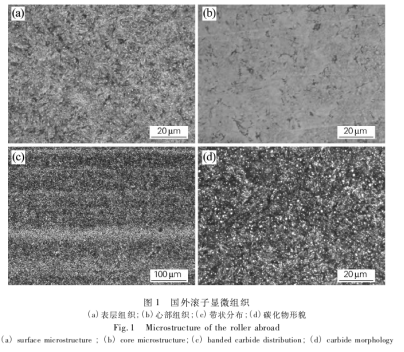
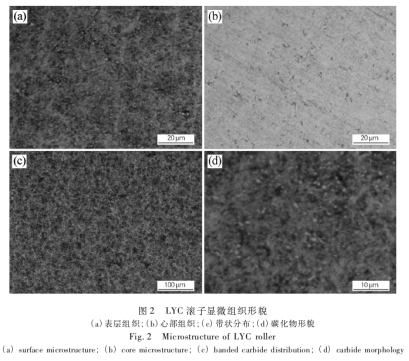
The microstructure and hardness are evaluated in accordance with JB/T 1255-2014 “Technical Conditions for Heat Treatment of Rolling Bearing High Carbon Chromium Bearing Steel Parts”. The heat treatment quality of rollers at home and abroad meets the standard requirements, and T represents the troostite structure. As can be seen from Table 3, the heat treatment quality of LYC rollers is equivalent to that of foreign bearing rollers. Since domestic rollers are salt bath quenched and tempered in a roller hearth furnace production line with a protective atmosphere, regardless of the control level and martensitic structure The uniformity of the troostite structure (see Figure 2(a)) and the control of the troostite structure (see Figure 2(b)) are not lower than the microstructure level of foreign bearing rollers (see Figure 1 (a) and (b)). The martensite structure on the surface of foreign bearing rollers is level 3, while the martensite structure on the surface of LYC rollers can reach level 2 to 3 compared with actual control; the shallow corrosion structure in the center of LYC rollers There is only a small amount of troostite, but the shallow corrosion of the core structure of foreign rollers has troostite level 2. Compared with the band structure, foreign raw materials exist, but the carbides are evenly distributed on the band ((see Figure 1(c))) ; while LYC rollers have no banded distribution ((see Figure 2(c))); compared with network carbides, foreign rollers exist, and the size of single particle carbides is larger ((see Figure 1(d)), while LYC There is no network carbide in the structure, and the carbide particles are distributed finely and evenly (see Figure 2(d)). Comparing the hardness of the roller core, the hardness gradient of the LYC roller does not change much, and is slightly higher than the core hardness of foreign rollers. . Judging from the mesh carbide and strip carbide, the quality of domestic bearing roller raw materials is equivalent to that of foreign raw materials.
Retained austenite on the surface
The portable Xstrees3000 X-ray stress meter was used to test the residual austenite content of the longitudinal cross-section samples of the two rollers. The results of the residual austenite testing of bearing rollers at home and abroad are shown in Table 4.
Judging from the test values of surface retained austenite, the domestic retained austenite content is greater than that of foreign rollers. It can be seen that the bearing rollers of this type of rolling mill belong to the martensitic quenching process and adopt salt bath quenching and tempering heat treatment. However, my country’s bearing industry JB/T 1255-2014 stipulates retained austenite. For the retained austenite in the salt quenching method, the retained austenite changes little after re-tempering. Although the retained austenite content is relatively high, tempering at 200°C has little effect on it. In terms of retained austenite, if LYC rollers are used in rolling mills, the heat treatment method of Mapei composite quenching can be used to replace the original martensite quenching of the rollers. The structure obtained after quenching is not a single bainite structure, but It is a composite structure mainly composed of bainite and containing a small amount of martensite. This “Martensite composite structure” not only has high strength and hardness, but also has good impact properties, which can meet the service conditions of rolling mill bearings. In order to obtain this kind of composite structure, the process plan adopts martensitic transformation first and then quenching. The part with low carbon content in austenite transforms into martensite, and the part with high carbon content in austenite transforms into martensite. The subsequent lower bainite transformation temperature above the Ms point is transformed into lower bainite in an isothermal process. After final quenching, the amount of retained austenite is small and the dimensional stability is high. The martensite structure transformed during the first quenching process is tempered in time when the subsequent bainite transformation temperature is isothermal, so cracks are less likely to occur during the quenching process. The process adopts: quenching heating temperature 860℃, heating time 84min, first cooling temperature 180℃, isothermal temperature 230℃, isothermal time 5h.
Table4 Comparison of the retained austenite concent(%)
| LYC roller (outer diameter surface) | foreign roller (outer diameter surface) | ||||
| Point 1 | Point 2 | Point 3 | Point 1 | Point 2 | Point 3 |
| 20.3 | 24.1 | 23.1 | 17.8 | 21.2 | 20.5 |
| 23.8 | 21.5 | 20.2 | 17.2 | 17.0 | 19.0 |
Grain size comparison
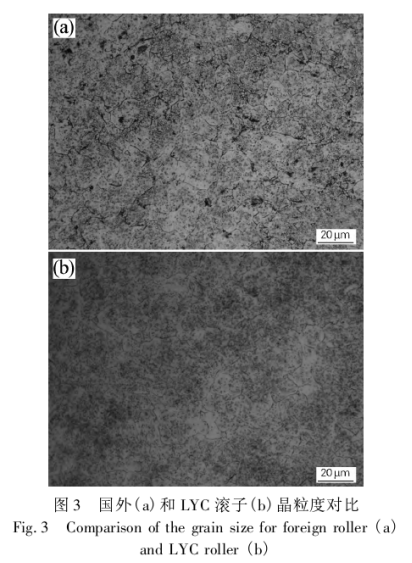
According to the grain size display in GB/T 6394-2002 “Metal Average Grain Size Determination Method”, the etching agent is 2g picric acid + 1g sodium triphenylsulfinate + 100mL H2O, corrosion at room temperature; it can display high carbon Austenite grain size after quenching and tempering of chromium bearing steel. Use a metallographic microscope to grade according to the GB/T 6394-2002 standard and the artificial intercept point method. The comparison of the grain sizes of the two rollers is shown in Figure 3. The foreign roller is grade 10.2, and the LYC roller is grade 10.4. There are many factors that affect the grain size. The most important ones are the chemical composition of the material and the heating temperature and holding time during heat treatment. The higher the heating temperature and the longer the holding time during heat treatment, the coarser the grains will be, and vice versa. This further illustrates that the heat treatment and quenching heating temperatures of the two are similar and belong to a reasonable temperature distribution.
Conclusion
1) The chemical composition of domestic electroslag bearing steel roller materials with similar specifications is close to that of foreign rolling mill bearing roller materials, and the raw material quality is intact, so GCr15 electroslag bearing steel can be used to replace foreign rolling mill bearing roller materials.
2) The heat treatment quality of domestic bearing rollers such as microstructure, grain size, and hardness is equivalent to that of foreign countries, but the control of retained austenite is slightly higher than that of foreign countries. It can be obtained by carrying out the heat treatment process first and then second. Good mechanical properties.
3) With the promotion and application of Mapei production line, the heat treatment process of “Mabei composite structure” can be realized: it is recommended to use quenching heating temperature of 860°C, heating time of 84min, first cooling temperature of 180°C, and isothermal temperature of 230°C. , the isothermal time is 5h for small batch trial production.