This article introduces the characteristics and key points of installation, operation and maintenance of the oil and gas lubrication system of the work roll bearings of a cold rolling mill, and proposes solutions to common faults during operation.
Keywords: cold rolling mill; work roll bearing; oil and gas lubrication
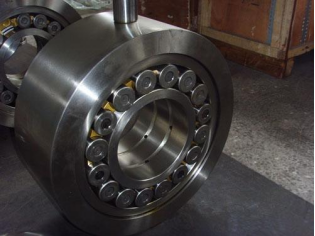
The CDCM unit of a cold rolling mill is the first combined pickling mill unit introduced in China and is at the internationally advanced level. Among them, the work roll bearings (four-row tapered roller bearings) of the rolling mill stands 1# to 4# adopt the oil and gas lubrication technology of REBS Company. The work roll bearings of rolling mills use tandem bearings, which have multiple friction pairs, and the seals at the roll neck also need to be lubricated. Therefore, it is required that the lubricating oil can quickly penetrate into each friction pair, and it is also necessary to consider supplying different lubrication amounts to the bearings and roll neck seals respectively; in addition, because the bearing seat is washed by the emulsion, the emulsion will inevitably invade the bearing seat. harm bearings. REBS’s TURBOLUB oil and gas lubrication system can successfully solve the above lubrication problems of tandem bearings. The author of this article discusses the characteristics of oil and gas lubrication systems and issues that should be paid attention to in operation and maintenance.
Characteristics of oil and gas lubrication system design
Working principle of oil and gas lubrication technology
The continuous action of compressed air is used to drive the lubricating oil to continuously flow along the inner wall of the pipeline to form a turbulent oil-air mixture, which is supplied to the lubrication point in the form of fine oil droplets. This process is oil-air lubrication. Compressed air is supplied continuously, and oil is supplied intermittently. The intermittent time and oil supply amount can be set according to the consumption of each lubrication point.
The oil and gas lubrication system is a comprehensive equipment integrating machinery, electricity and gas. The main equipment is:
(1) Oil supply part: The fuel tank capacity is 500L; there are two oil supply air pumps (one for use and one for backup). The displacement of the air pump is 6ml per stroke, and the normal working pressure is about 6MPa.
(2) Compressed air part: The compressed air passes through the filter, solenoid valve and pressure reducing valve to set the pressure to 0.3~0.4MPa. It reaches turbulent flow when mixed with lubricating oil in the oil and gas mixing block. The compressed air pressure shall not be lower than 0.2MPa.
(3) Distribution and mixing part of lubricating oil: There is a progressive distributor at the outlet of the air pump. The lubricating oil is accurately distributed by the progressive distributor and then enters the downstream 4 sets of oil and gas mixing blocks, where it is mixed with compressed air to form an oil and gas flow. , the oil and gas flow is transmitted to each lubrication point through the pipeline.
(4) TURBOLUB sleeve modular oil and gas distributor: installed in the work roll bearing seat, the oil and gas flow is secondary distributed to the bearings and sealing parts by the TUR-BOLUB oil and gas distributor in the required amount.
(5) Pipeline: A stainless steel pipe with an outer diameter of Φ10mm is connected to the lubrication points at both ends of the work roll bearing seat. The pipe layout has no impact on the transportation of oil and gas.
(6) Electrical control and monitoring devices: The system is equipped with many electrical monitoring devices to detect flow, pressure, working time, stop time of the air pump, display components and system faults, etc.
Advantages of oil and gas lubrication technology
(1) The gas-liquid two-phase oil film of oil-gas lubrication greatly improves the load-bearing capacity of the oil film, reduces friction loss, improves lubrication efficiency and the service life of the bearing.
(2) Oil and gas are continuously supplied to the bearing seat. The gas-liquid two-phase oil film produced by the oil and gas is fresh, and the load-bearing performance is not damaged.
(3) Compressed air flows into the bearing seat and overflows from the bearing seat, which can take away a large amount of heat and effectively reduce the temperature of the bearing;At the same time, the sealing performance of the bearing seat is enhanced. The compressed air can maintain a positive pressure of 30 to 80kPa in the bearing seat, so that external emulsion and other dirt cannot invade the bearing seat and harm the bearing.
(4) The oil supply is accurate to prevent excess lubricant from filling the inner cavity of the bearing, which not only reduces the viscous resistance but also reduces the lubricant consumption. It will not cause pollution to the emulsion, rolling mill and surrounding environment like dry oil lubrication.
(5) There is no limit on the size of lubricated equipment, the pipelines are simple and the layout of the pipelines is not restricted by their direction.
(6) The system has few moving parts, reliable operation, and low maintenance, which greatly reduces the operation and maintenance costs of lubricated equipment.
(7) Complete monitoring means and high degree of electromechanical integration prevent bearings from running without lubrication and make maintenance easy.
Setting of system parameters
Lubrication quantity calculation formula for each bearing
QG=C₁×(Q₁×N₁+Q₂×N₂+…+Qx×Nx)
In the formula: QG is the amount of oil required for all bearings; Nx is the number of bearings of the same type; G is the safety factor (1.08).
Table 1 Oil consumption of work roll bearings
| Lubricating objects | Bearing size | quantity | Consumption/(cm3.h-1) | |
| single | total | |||
| Four row tapered roller bearings for work rolls | ∮342mm×457mm×254mm | 16 | 6.0 | 96.0 |
Lubrication interval
Tp=3600s×ZU×QM/QG
In the formula: Tp is the lubrication interval time; ZU is the rotation speed setting of the working cycle distributor of the lubrication system; QM is the distributor displacement; QG is the amount of lubricating oil required by the system.
After calculating the oil supply cycle, it can be obtained that Tp=110s. After a period of operation observation, setting Tp=80s can meet the requirements of equipment lubrication.
Key points for installation, operation and maintenance
When installing and using the oil and gas lubrication system, the cold rolling mill drew on the practical application experience of other plants and adopted many improvement measures to ensure the normal operation of the oil and gas lubrication system. Here is a brief summary:
(1) Compressed air quality is particularly important for the stable operation of the oil and gas lubrication system. If the compressed air is too dirty, pollutants can easily block the oil and gas distributor, causing great harm to the system. Therefore, a secondary filtration device with automatic sewage discharge device was added during the installation of the equipment. That is, the main line filter AFF22B-10 (3μm) and the oil mist separator AAM550-10 (0∙3μm), both of which have filter element clogging indicators, can know the degree of filter element clogging in time, thereby determining the time to replace the filter element. Through the filtration of these two-stage filters, the dust, moisture and oil in the compressed air are basically removed, and the filtration effect is very ideal. Failures caused by dirty compressed air have never occurred.
(2) Increase the pressure and flow rate of compressed air. Compressed air is a natural coolant. Since compressed air can maintain a certain positive pressure in the bearing seat, there is a large pressure difference between the positive pressure in the bearing seat and the pressure of the compressed air sent into the bearing seat. This large pressure difference can continuously cool the bearings. The greater the flow rate of compressed air, the better the cooling effect. Therefore, by adjusting the system pressure reducing valve, the compressed air pressure is increased to 40KPa; the diameter of the compressed air pipeline is enlarged to increase the compressed air flow and pressure difference, thereby enhancing the cooling effect of the bearing.
(3) The oil and gas pipelines use stainless steel pipes, which can reduce the workload of inspection and maintenance and avoid tank burning failures. Since the oil and gas pipelines in the rolling mill frame area have been in contact with emulsion vapor for a long time, if carbon steel pipes are used, the pipelines will be corroded and damaged over time, resulting in leakage, resulting in insufficient lubricating oil reaching the lubrication point, resulting in box burnout .
(4) Due to the increase in production output = (annual output increased by 300,000 tons), the rolling speed also increased accordingly. Therefore, according to actual needs, the air pump is changed from supplying oil once every 80 seconds to once every 60 seconds to increase the amount of lubricating oil to the bearings and improve the cooling effect accordingly.
(5) All seals should be made of materials compatible with the selected oil. Generally, fluorinated rubber or nitrile rubber is preferred.
(6) Keep the quick joint at the bearing seat clean and prevent dirt from entering. Otherwise, dirt blocking will cause the quick connector not to be inserted in place, the oil passage will be blocked or the opening will be too small, resulting in insufficient oil entering the bearing and causing box burn. In addition, dirt will clog the filter in the bearing seat, causing insufficient oil to enter the bearing, resulting in box burning.
(7) Strengthen the assembly quality of the bearing seat to avoid box burn due to poor assembly of the bearing seat or entry of stolen goods, resulting in poor oil and gas lubrication or insufficient oil volume.
(8) Strengthen daily spot inspections, check whether the system air pressure and oil pressure are normal, and whether the distributor moves flexibly. Whether there is oil and gas in each transparent plastic tube connected to the oil and gas mixing block, and whether a vortex or turbulent flow state is formed. If the oil and gas flow is too fast and no vortex-shaped oil and gas flow is formed, it means that the pipeline is too long, the pressure loss is large, and the lubrication effect is not good. If the flow rate of oil and gas is too slow, it indicates that the system may be clogged, causing the oil circuit to be blocked. At this time, pay attention to check whether the oil and gas distributor, quick connector, filter screen and air filter in the bearing seat are blocked by contamination, and whether the quick connector is inserted in place, etc.
(9) During regular maintenance, check whether there is leakage in the system pipeline (after the quick connector at the bearing seat is disconnected, if there is oil and gas flowing in the transparent plastic tube connected to the oil and gas mixing block, it means there is leakage in the pipeline), whether the joints are deformed, and whether the hose is wear and tear. Contaminated quick connectors need to be cleaned in time, and damaged hoses, joints and pipelines need to be replaced in time.
If the machine is shut down for a long time for maintenance (annual maintenance, overhaul, etc.), the compressed air source should be turned off so that the pneumatic pump cannot output lubricating oil (above 6MPa). Prevent lubricating oil from pouring back into the compressed air pipeline due to the pipeline outlet being closed (the quick connector is unplugged).
Conclusion
In order to ensure the stable operation of the oil and gas lubrication system, the system has been improved from design, manufacturing, installation to maintenance and repair. After the improvement, the oil and gas lubrication system is basically in a “zero fault” operating state. After the oil and gas lubrication system was put into use, the lubrication status of the work roll bearings was improved. Statistics show that the oil consumption of the modified oil and gas lubrication system is 1/10 of the oil consumption of grease lubrication. It has basically eliminated the occurrence of bearing burnout, box deformation and roll neck adhesion caused by poor lubrication, and achieved good economic benefits.