According to the characteristics of rolling mill bearings and the actual operation conditions in production, starting from the design, material selection, technology and use, various factors affecting the life of the bearings are analyzed, and measures are taken to improve the service life of the rolling mill bearings and reduce bearing losses. Improved production efficiency and reduced production costs.
Keywords: rolling bearing; rolling mill bearing; life; reliability
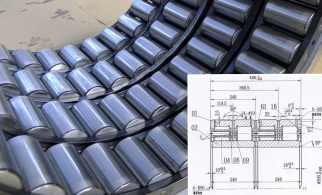
Nowadays, rolling bearings are widely used in the support of medium and heavy plate rolling mill rolls (especially work rolls) in various countries around the world. The work rolls of plate rolling mills generally use four-row conical or cylindrical roller bearings. Due to the limitation of the size of the roll, the radial space of the bearing seat and the bearing is small, and the design of the bearing is restricted. In particular, the four-row cylindrical roller bearings used as work rolls, although they bear heavy loads, can only be designed as light series and are wearing parts of the rolling mill. In production consumption, the consumption of bearings only accounts for about 5% of the total consumption, but its impact on steel rolling output reaches 20%. Therefore, as a key component of the rolling mill, bearings malfunction during the maintenance cycle and lead to production shutdown. This is something that manufacturers cannot tolerate. . This article discusses measures to be taken from design, material selection, manufacturing and application to improve the service life of rolling mill bearings.
Bearing design
If the life of the bearing is expressed in terms of working hours, the life of a roller bearing with 90% reliability is

In the formula: Ln is the calculated life of the bearing, h; n is the bearing speed, r/min; Pr is the equivalent radial dynamic load of the bearing, N; Cr is the basic radial dynamic load rating of the bearing, N; K is the material coefficient (vacuum detachment) Gas steel K =3). It can be seen from the above formula that the main factors affecting bearing life are Cr and K. According to ISO281, the dynamic load rating of roller bearings is

In the formula: fe is the structure correction coefficient; a2 is the material correction coefficient; Lwe is the effective length of the roller; i is the number of rolling element rows; Z is the number of single row rollers; α is the contact angle; Dwe is the average diameter of the rolling element. When designing bearings, the higher the Cr value, the longer the life of the bearing. Among the dimensional parameters Lwe, Z, and Dwe that determine the Cr value of the bearing, Dwe has the greatest influence. At the same time, fe, K, and a2 also play a key role in the reliability and life of the bearing. (1) Among the dimensions and parameters of the bearing, the increase in Dwe has the greatest impact on the Cr value. Increasing the Dwe value should be the preferred solution pursued in the design, but the strength of the inner and outer rings of the bearing is required to meet the requirements. This is an important way to improve bearing life. However, since bearings are the basic parts of various machines, the use conditions of various types of bearings are quite different. In addition, the thinning of the bearing rings will bring some problems to the bearing manufacturing. Therefore, the selection of the strength coefficient must be cautious and should be based on the analysis of use and Start with the processing conditions and improve them step by step. (2) A slight difference in fe in the bearing design will cause the dynamic load rating of the entire bearing to change. If there is stress concentration on the roller or raceway in the structure, the rated load will be reduced. However, if the load along the entire length of the roller is The stress distribution is uniform and the stress concentration is small, so the rated load can be increased. (3) It can be seen from equations (1) and (2) that K and a2 are important to bearing life. During the rolling process, medium plate rolling mill bearings are subject to alternating loads and large impact loads. Carburized bearing steel is generally used. Since carburized bearing steel is a high-alloy steel, impurity brittle oxides (especially alumina) will become the source of fatigue cracks, causing premature fatigue fracture of the bearing. Electroslag remelted steel 20Cr2Ni4A should be used with low oxygen content, fine oxides and good dispersion. Bearing material is an important factor affecting bearing life and reliability.
Influence of processing technology and processing equipment
Since the medium plate rolling mill bearings are subject to variable impact loads and have the characteristics of high speed, heavy load, and poor working environment, it is required that the components of the rolling mill bearings must not have weak parts. In order to improve the manufacturing level of rolling mill bearings, some manufacturers have introduced internationally advanced large-scale bearing processing equipment and testing equipment. However, during exchanges and visits, it was discovered that individual manufacturing plants have the following problems that need improvement. (1) Some bearing manufacturing units do not select materials in a standardized manner. In order to reduce costs, GCr15SiMn and GCr18Mo are used instead of carburized steel. Although the hardness of the bearing can meet the requirements, the toughness is lower than that of carburized steel. The rated dynamic load of the bearing is reduced and the service life is reduced. (2) The carburizing process is a special process in heavy-duty bearing manufacturing. In order to reduce costs, some manufacturers use high-temperature strong carburizing and reduce grinding processing allowance. Coarse network carbides and soft spots appear on the surface of the bearing, and the grains of the infiltration layer are coarsened, causing premature fatigue spalling and failure of the bearing. Therefore, the carbide grains must be refined. The average carbide diameter is refined from 1.14 μm to 0.6 μm, and the service life will be increased by 4 times. (3) Some manufacturers expand the processing range of grinders, or use turning machines instead of grinding, resulting in poor surface roughness of the bearings, reducing the lubrication capacity, and causing adhesive wear. In addition, due to the low precision of the processing equipment, the processed products cannot ensure that the four rows of rollers are evenly stressed. According to equations (1) and (2), the impact of uneven stress on the four rows of rollers on the bearing life can be calculated, see Table 1.
| Table 1 Effect of the number of rolling element stress columns on life | ||||
| Number of force columns | 4 | 3 | 2 | 1 |
| Cr | 1.0 | 0.7995 | 0.5833 | 0.3402 |
| La | 1.0 | 0.4743 | 0.1658 | 0.0275 |
It can be seen from this that even if high-quality electroslag remelted steel 20Cr2Ni4A is used, if the bearing process is unreasonable and the processing accuracy does not meet the requirements, the service life of the bearing will not only not be improved, but will also be reduced.
Influence of rolling mill usage conditions
The influence of rolling mill usage mainly includes: load and load distribution on bearings, rolling speed, lubrication and sealing, temperature rise and heat dissipation. (1) If the flatness of the rolling mill arch is too large, the size of the bearing box is out of tolerance, and the wall thickness is inconsistent, cross-rollers will occur, and an interaction force will be generated between the two rollers. The axial force and uneven stress on the rollers will be greatly affected. Reduce the fatigue life of bearings. Similarly, when the thrust force caused by the cross roller is reduced from 5% to 0.5% compared with the rolling mill component force, the calculated fatigue life is increased. Therefore, it is necessary to keep the rotation axes of the upper and lower work rollers and the upper and lower support rollers in the same vertical plane, and the rotation axes of each roller are parallel to each other. Conduct regular inspections and maintenance of archways. Bearing boxes should be used in groups, and bearing boxes in the same group should be repaired together to ensure that the axis coaxiality of the bearing boxes is not greater than 1′. (2) Lubrication has become one of the key factors to improve bearing life. Choosing the right lubricant is the basis for ensuring that the bearings are in good condition. According to the oil film coefficient formula, the minimum oil film thickness hmin is determined, which is related to the minimum oil film coefficient λ and the surface roughness values δ1 and δ2 of the two contact parts. According to experimental research, when the minimum oil film coefficient λ≧3, the bearing is in complete elastohydrodynamic lubrication. Select the appropriate lubricating oil viscosity eta0 according to the Dowson-Higginson minimum oil film calculation formula.

In the formula: hmin is the minimum oil film thickness; α is the pressure index of viscosity; eta0 is the dynamic viscosity under normal pressure, u is the average surface velocity; E0 is the equivalent elastic modulus; R is the equivalent radius of curvature; q is the unit contact length load. According to the quality, size, load and rotation speed of the bearing working surface, the lubricating oil corresponding to the viscosity coefficient eta0 is determined. In various lubrication systems, sealing is an important guarantee for achieving lubrication effects. If the seal is not good, the lubricating oil will leak out, and impurities such as cooling water and oxide scale will also enter the inside of the bearing, causing the bearing to be short of oil and the lubricating oil to hydrolyze and creep, which will destroy the function of the lubricating oil, causing the bearing to burn out and get stuck. It may even cause the rollers and bearing boxes to be scrapped.
Conclusion
(1) The working conditions and characteristics of medium plate rolling mill bearings require high comprehensive mechanical properties. The selection of high-quality steel is a prerequisite for reasonable and optimized selection of bearing design parameters in a limited space, and is a guarantee for increasing its rated life. (2) Use advanced processing equipment (large CNC processing equipment), improve processing techniques and methods, improve the dimensional and positional accuracy and intrinsic quality of bearings, improve the reliability and life of medium plate rolling mill bearings, and eliminate defects caused by abnormal damage downtime. (3) Strengthen the daily maintenance of the rolling mill to ensure that the technical parameters of the rolling mill are within the required range; select appropriate high-quality lubricating oil and reasonable lubrication methods, and strictly seal the bearings to ensure that the bearings are in complete elastohydrodynamics lubrication state, thereby increasing the life of the bearing.